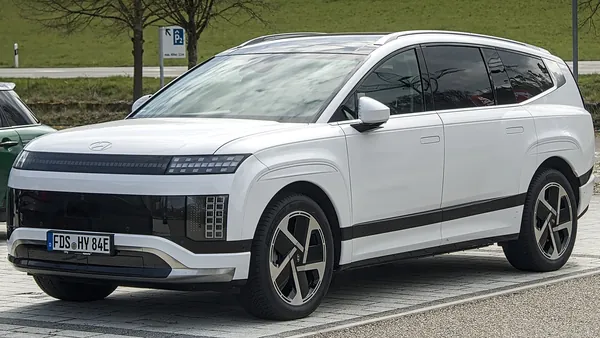
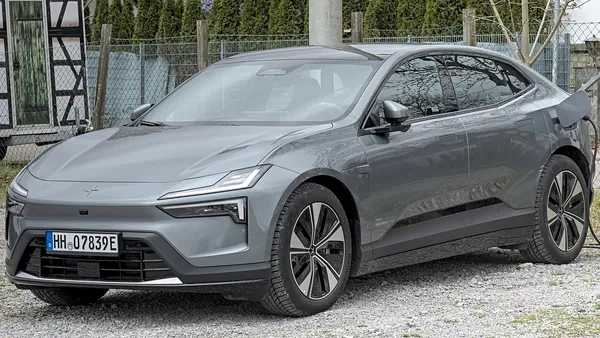
Hyundai Ioniq 9 vs Polestar Polestar 4
The Polestar Polestar 4 is cheaper to start, by $2,555. The Hyundai Ioniq 9 goes further, with up to 335 mi of rated range versus 310 mi. The Hyundai Ioniq 9 fast-charges faster (350 kW peak versus 200 kW, base trims). The first table compares base trims; every new trim of each is listed further down.
Which one should you pick?
Pick the Hyundai Ioniq 9 if…
- you want more range: up to 335 mi rated (about 248 mi in winter, our estimate), versus 310 mi for the Polestar Polestar 4.
- you fast-charge on road trips: about 24 minutes for 10-80% on its quickest trim, versus 38 minutes for the Polestar Polestar 4 (our estimate).
- you need cargo space: up to 84.8 cu ft, versus 54.2 cu ft for the Polestar Polestar 4.
- you need a third row: it seats up to 7, and the Polestar Polestar 4 seats 5 at most.
- you tow: it is rated for up to 5,000 lbs, versus 3,500 lbs for the Polestar Polestar 4.
- you want to plug straight into Tesla Superchargers: every new trim has a native NACS port, and the Polestar Polestar 4 uses CCS1, so it needs an adapter.
Pick the Polestar Polestar 4 if…
On the measures we compare, the Polestar Polestar 4 is not clearly ahead of the Hyundai Ioniq 9. Check the trims below for smaller differences.
Based on new trims of both models. How we compare
| Spec | Hyundai Ioniq 9 | Polestar Polestar 4 |
|---|---|---|
| Starting MSRP | $58,955 | $56,400 |
| Base trim | S RWD | Long Range Single Motor |
| Max rated range | 335 mi | 310 mi |
| Winter range (base, est.) | 248 mi | 229 mi |
| Battery (base) | 110.3 kWh | 100 kWh |
| Peak DC charging (base) | 350 kW | 200 kW |
| Est. 10-80% charge | ~24 min | ~38 min |
| 0-62 mph (base) | — | 7.1 s |
| Drivetrains | RWD, AWD | RWD, AWD |
| Max cargo | 84.8 cu ft | 54.2 cu ft |
| Charging port | NACS | CCS1 |
Trim by trim
MSRP before destination, dealer fees and taxes. Winter range and 10-80% charge times are our estimates.
Hyundai Ioniq 9: 6 new trims
| Trim | MSRP | Range | Winter est. | Battery | Peak DC | 10-80% est. | 0-62 mph | Drive |
|---|---|---|---|---|---|---|---|---|
| S RWD 2026 |
$58,955 | 335 mi | 248 mi | 110.3 kWh | 350 kW | ~24 min | — | RWD |
| SE AWD 2026 |
$62,765 | 320 mi | 237 mi | 110.3 kWh | 350 kW | ~24 min | 5.2 s | AWD |
| SEL AWD 2026 |
$66,320 | 320 mi | 237 mi | 110.3 kWh | 350 kW | ~24 min | 5.2 s | AWD |
| Performance Limited AWD 2026 |
$71,250 | 311 mi | 231 mi | 110.3 kWh | 350 kW | ~24 min | — | AWD |
| Performance Calligraphy AWD 2026 |
$74,990 | 311 mi | 231 mi | 110.3 kWh | 350 kW | ~24 min | — | AWD |
| Performance Calligraphy Design AWD 2026 |
$76,490 | 311 mi | 231 mi | 110.3 kWh | 350 kW | ~24 min | — | AWD |
Polestar Polestar 4: 2 new trims
| Trim | MSRP | Range | Winter est. | Battery | Peak DC | 10-80% est. | 0-62 mph | Drive |
|---|---|---|---|---|---|---|---|---|
| Long Range Single Motor 2025-2026 |
$56,400 | 310 mi | 229 mi | 100 kWh | 200 kW | ~38 min | 7.1 s | RWD |
| Long Range Dual Motor 2025-2026 |
$64,300 | 280 mi | 208 mi | 100 kWh | 200 kW | ~38 min | 3.8 s | AWD |
Compare every spec side by side →
How we compare
We call out a difference only when it is big enough to matter: a starting price at least 5% lower, at least 20 mi (and 5%) more rated range, a 10-80% fast charge at least 5 minutes quicker, at least 3.5 cu ft (and 10%) more cargo space, at least 1,000 lbs (and 15%) more towing, or a feature one model offers on at least one trim and the other on none: all-wheel drive, a third row, a native NACS port, V2L, or a heat pump as standard on every trim. We compare new trims, or every trim for a model sold used only. Winter range and charging times are our estimates. We found 6 such differences between these two.